You’ve heard about AI search. You’ve probably nodded along in a meeting where someone mentioned “GEO” or “generative engine optimisation.” You might have made a mental note to look into it. But have you actually typed your company name into ChatGPT and read what it says back?
For many marketing managers at science and laboratory equipment companies, the answer is no – or “not recently.” That’s understandable. The pace of change in AI over the past two years has been genuinely disorienting, and not every development has practical implications for your day-to-day work.
But this one does. Because right now, researchers, scientists, and procurement managers are increasingly turning to AI tools – ChatGPT, Google’s AI Mode, Gemini – not just for general knowledge, but to answer specific, purchasing-adjacent questions. Questions like:
- “What’s the best spectrophotometer for nucleic acid quantification?”
- “Who are the leading suppliers of benchtop centrifuges for clinical labs?”
- “What should I look for when evaluating a particle size analyser?”
Your potential customers are asking these questions. The answer they get back either includes your brand – or it doesn’t. Understanding why, and what you can do about it, doesn’t require a deep dive into machine learning. It requires understanding one key distinction.
The New Search Landscape: A Quick Reality Check
For most of the internet era, search meant ten blue links. Someone typed a query, got a list of pages, and chose where to click. SEO – search engine optimisation – was built entirely around that model.
AI search is different. Instead of presenting a list of options, tools like ChatGPT or Google’s AI Mode generate a direct answer. They synthesise information from multiple sources and present it as a single, confident response. The links, if they appear at all, are secondary to the text.
For science and laboratory businesses, this matters more than it might for other sectors. Your buyers are information-heavy decision-makers. A researcher evaluating a new instrument isn’t going to buy on impulse – they’re going to research thoroughly, and increasingly, that research begins with an AI query rather than a search engine.
The question is no longer just “where do we rank on Google?” It’s “what does AI say about us when our buyers ask?”
Citations vs. Mentions: The Distinction That Changes Everything
Here’s the concept that most science marketers haven’t encountered yet, but will soon hear a lot about.
When your brand appears in an AI-generated response, it can appear in two fundamentally different ways: as a citation or as a mention. These may sound similar, however, they are very different.
What Is a Citation?
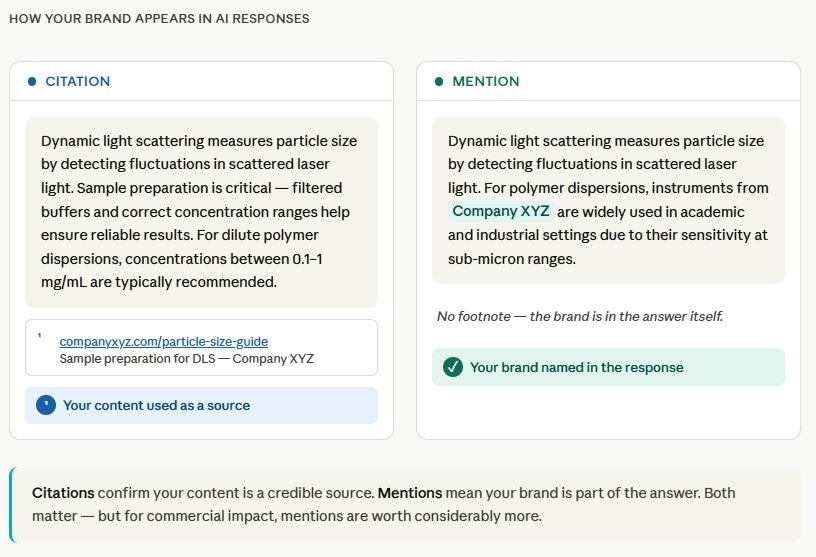
A citation is when AI links to one of your pages as a source. Think of it like a footnote; the AI used your content to help construct its answer, and it acknowledges that by referencing your URL. If you’ve invested in informational content: technical blogs, application notes, method guides etc. you’re probably already earning citations.
Citations are valuable. They signal topical authority, they can drive some traffic, and they demonstrate that your content is credible enough for AI to rely on. But here’s the limitation: Do readers really click on the AI footnotes?. The information has already been delivered. The citation confirms your content was useful; it doesn’t necessarily bring the reader to you.
What Is a Mention?
A mention is when your brand name appears directly in the generated text. Not as a link. Not as a footnote. As part of the answer itself.
“For polymer dispersions, instruments from Company XYZ are widely used in academic and industrial settings due to their sensitivity at sub-micron ranges.”
That’s a mention. And that’s worth considerably more, commercially speaking, than a citation. Because the reader doesn’t need to click anywhere – your brand is woven directly into the answer they’ve received.
A Simple Way to See the Difference
Think about Wikipedia and Nike.
Wikipedia earns an enormous number of citations in AI responses – it’s one of the most-cited sources on the web. But it’s rarely mentioned by name within the generated text itself. AI uses it as a reference but doesn’t often say “according to Wikipedia.”

Nike, by contrast, gets mentioned constantly – “Nike’s Air Max range...” “Leading brands like Nike...” – but rarely cited as a source. Nobody’s linking to nike.com as a factual reference.
Informational content gets you cited. Brand strength gets you mentioned. For science companies, most current content strategy is optimised for the former – and largely ignores the latter.

Where Most Science Companies Currently Sit
If your company has invested in content marketing over the past few years – technical articles, blog posts, application notes, white papers – you are almost certainly earning AI citations. That’s genuinely good. It means your content is credible, indexed, and useful enough for AI to reference.
But there’s a common gap. Much of this content is written to be rigorously objective. That’s appropriate for a scientific audience – researchers are sceptical of promotional language, and rightly so. The consequence, however, is that the content talks around your brand rather than for it.
An article about “best practices in flow cytometry sample preparation” might be excellent – well-researched, well-written, ranking well in search. But if it mentions your company only briefly, in a closing paragraph, the AI learns that this article is authoritatively about flow cytometry. It doesn’t learn that your company is authoritatively associated with flow cytometry.
That’s the gap most science marketers have right now: strong informational content, weak brand fingerprint within it.
What You Can Actually Do About It
The good news is that you don’t need to overhaul your content strategy. You need to refine it. Here’s how to think about it practically.
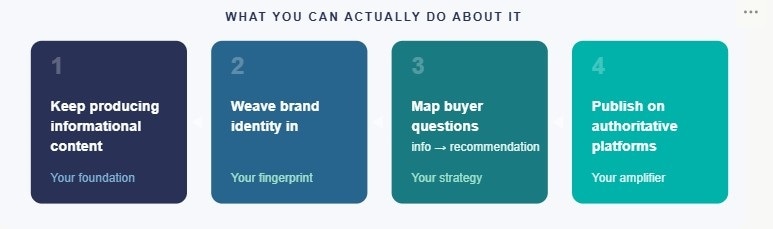
1. Don’t Abandon Your Informational Content
Your existing technical content is the foundation of your AI visibility. The citations it earns represent genuine topical authority – AI knows your domain. That’s hard-won and worth protecting. Keep producing high-quality informational content.
2. Weave Brand Identity Into Technical Content
The shift isn’t from “informational” to “promotional.” It’s from “generic topical authority” to “branded topical authority.” The goal is for AI to associate your specific company name with the topics you already own.
In practical terms, this means:
- Case studies and application content where your instrument is central to the methodology (not just mentioned in passing).
- Expert commentary attributed explicitly to named scientists or specialists at your company.
- Content that frames your company’s approach, philosophy, or methodology as distinctive – not generic category content with a logo on it.
- Conclusions and summaries that reinforce your brand’s name alongside the expertise demonstrated in the article
3. Think About the Questions Your Buyers Are Actually Asking AI
There’s an important difference between informational queries and recommendation queries.
- Informational: “How does dynamic light scattering work?” – direct mentions are unlikely, you may already be getting citations
- Recommendation: “What particle size analyser should I use for polymer dispersions?” – this is where mentions happen, and where commercial impact is highest.
Mapping the types of questions your target buyers are likely to ask – and auditing what AI currently says in response – is a practical starting point. You may find you’re performing well on informational queries and largely absent from recommendation ones.
4. Consider Where Your Content Lives
AI models build their understanding from the web broadly, but they’re more likely to draw on content from authoritative, widely-indexed, trusted sources. A technical article published across a specialist scientific publishing platform carries more weight than the same content buried in a subdirectory of your corporate website.
The prominence and consistency of your brand’s voice across trusted third-party platforms – scientific journals, industry publications, specialist media networks – contributes to how AI comes to understand and associate your brand within its domain.
The Bottom Line for Busy Marketing Managers
You don’t need to understand transformer architecture or fine-tuning to act on this. Here’s the practical summary:
- AI search is where your buyers increasingly start their research.
- Your content can appear as a citation (source reference) or a mention (named in the answer).
- Mentions have higher commercial value. Most science companies currently earn citations and relatively few mentions.
- The fix isn’t a different content strategy – it’s a refinement: ensure your brand identity is woven into the authoritative content you already produce.
- Start by asking: when someone asks AI to recommend a supplier in your category, does your brand come up by name?
If you want to know where you stand today, AZoNetwork's free AI Visibility Report gives you a practical picture of how often your brand is being mentioned across the leading AI tools, which pages are being pulled into answers, and the technical factors most likely helping or holding you back.
Get your free AI Visibility Report