B2B marketing principles only go so far in the medical device market.
Generating qualified leads is harder here. Buying journeys are longer, regulatory scrutiny is tighter, and decisions often involve multiple stakeholders, including clinicians, procurement teams, regulatory staff, and hospital administrators, all of whom can influence the timeline of the final purchase.
Medical device companies are searching for more than clicks and visibility. They want qualified leads, clinical relevance, and proof that their solution delivers real value, making it easier for buyers to get approval from the wider team.
So, what makes medical device lead generation different from standard B2B campaigns? Usually, it comes down to reaching the right stakeholders with information that helps them solve real clinical and operational challenges. The next step is building trust through useful content, clear communication, and evidence buyers can easily share with their wider team.
A more targeted approach to lead generation is what helps turn medical device interest into genuine buying intent.
Before Anything Else, Define Your Ideal Lead
Don’t just launch immediately into a campaign before establishing your criteria for identifying high-quality leads. The more you know about your ideal buyers, the easier it becomes to build campaigns that attract genuinely relevant prospects.
For those in the medical device sector, qualification usually depends on who the buyer is, where they work, and how involved they are in the purchasing process. A hospital procurement manager researching capital equipment, for instance, will have very different priorities to a clinician who is evaluating usability or a regulatory specialist reviewing compliance requirements.
Begin by confirming your sales and marketing teams agree on what a strong lead actually looks like. In the medical device market, not every prospect has the same level of influence, clinical need, or purchasing authority. Defining what makes a strong lead early helps teams focus on buyers who are more likely to convert.
Who influences/approves the purchase?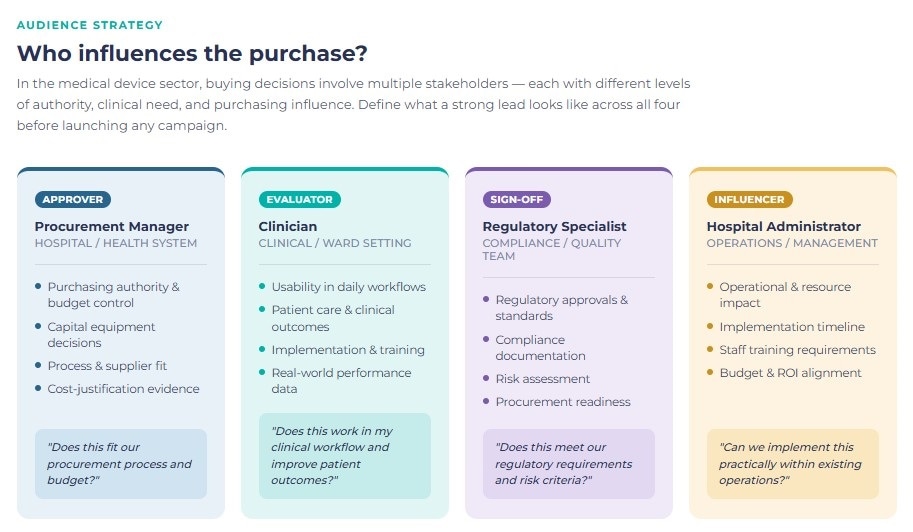
What makes the lead a strong fit?
- Whether the organisation works within the right clinical area
- Whether the organisation is a realistic fit for the device
- Whether the organisation is ready from a regulatory or procurement perspective
- Whether the prospect has influence over purchasing decisions
- Whether there is a genuine clinical or operational need for the solution.
When selling medical devices, engagement does not always mean a prospect is likely to buy. Someone might download a white paper, attend a webinar, or interact with your content regularly, but still lack the authority, budget, clinical need, or internal support to move the purchasing process forward.
This is why it is crucial to define what makes a strong lead early. Without clear qualification criteria, marketing campaigns can generate plenty of traffic but little genuine interest from buyers who are ready to move forward. Clear standards help marketing teams focus on higher-value prospects, improve targeting, and turn marketing activity into genuine pipeline opportunities.
Create Content That Helps Buyers Trust Your Medical Device
Generic promotional messaging is not enough to interest medical device buyers. Making statements like “market-leading solution”, “advanced medical technology”, “industry-leading performance”, or “next generation clinical solutions” may sound impressive, but they say very little about how a medical device performs in practice or how it supports clinical workflows.
Prospects are interested in content that focuses on device performance, clinical application, implementation requirement, and evidence they can use to support internal purchasing decisions.
Focus your content strategy on delivering credibility and practical value to decision-makers. For instance, don’t just rely on a broad product claim about your medical device, instead create content that shows how it performs in practice and delivers value. Case studies, workflow demonstrations, implementation guidance, and clinical outcome data are often far more effective than promotional messaging alone.
The way information is presented can have a major impact on engagement and lead quality. Some high-performing content formats include:
Practical technical articles work best when they focus on the 'how' and 'why' of a device rather than broad promotional claims. Explain how it supports day-to-day clinical tasks, reduces manual work, or improves decision-making for healthcare teams. Topics like how a device reduces reporting delays in connected systems, or how point-of-care technology improves efficiency in emergency settings, tend to attract more qualified leads because they speak directly to real workflow problems.
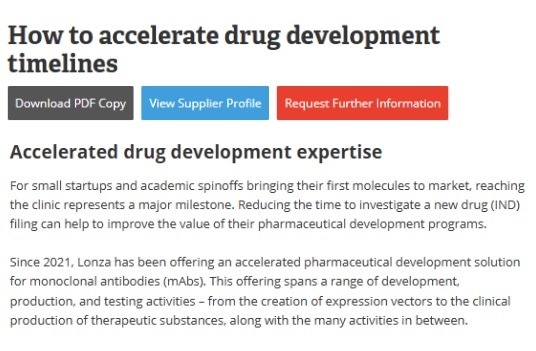
Case studies and clinical evidence give prospects the proof they need to move forward. Healthcare teams are far more likely to engage with content that demonstrates measurable outcomes and practical implementation. Strong evidence-led content includes clear context around how and where the device was used, performance improvements, and honest workflow insights from real-world use.
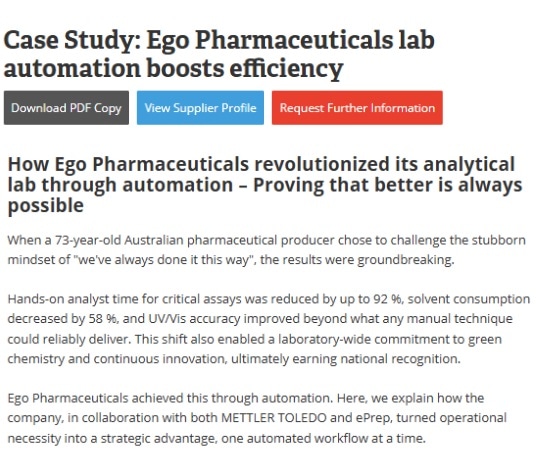
Product profiles and technology deep dives help technically minded readers assess fit. Cover device functionality, compatibility, integration requirements, regulatory approvals, and day-to-day clinical application in detail. The more useful information you include around setup, training, and implementation, the easier it becomes for the right buyers to identify your device as a relevant solution and take the next step.
Learn more about Product Profiles
Distribute Your Content Where Engagement Is Already High
You have successfully drafted your high-quality content. Now you need to make sure it reaches the right audience to ensure stronger lead quality and more meaningful engagement.
Qualified medical device leads rarely originate from broad consumer platforms like Facebook, Instagram, or general display advertising networks. They are more likely to come from places where healthcare teams actively research devices and compare solutions, such as industry publications, medical conferences, and LinkedIn.
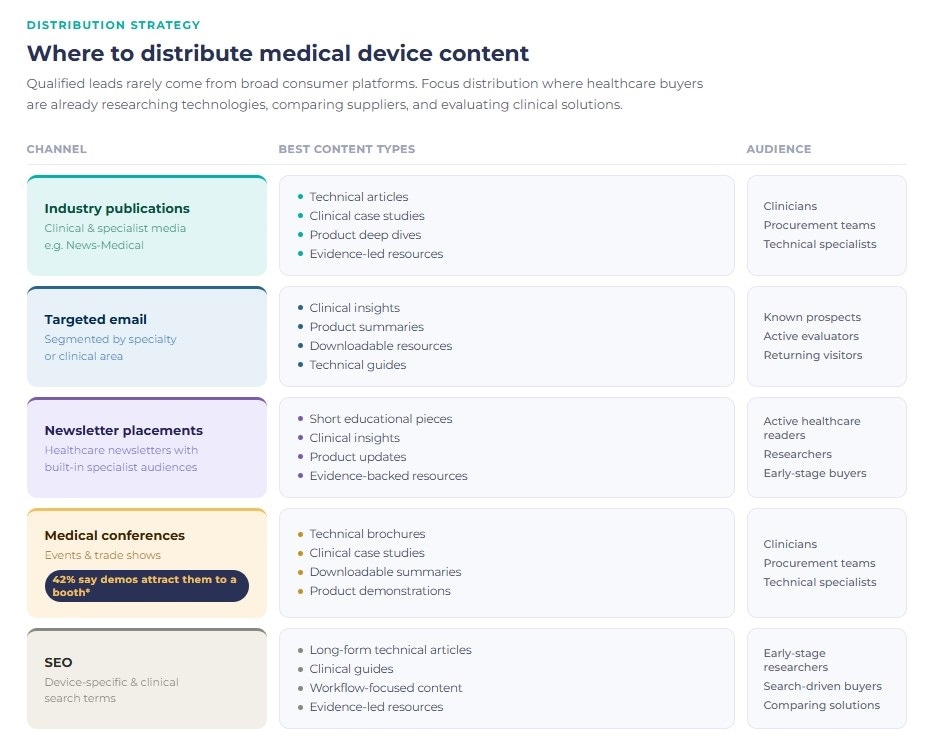
Buyers in these environments are usually searching for practical information, clinical evidence, and technologies that support specific operational or patient care challenges. Give them what they want by creating content that answers real clinical questions, explains how the device works in practice, and provides clear evidence that guides purchasing decisions.
Try distributing your content on the following channels:
Industry Publications
Publishing content through established healthcare, scientific, and engineering platforms can expand the reach of medical device companies to audiences already researching their type of technologies, comparing suppliers, or exploring solutions that address specific clinical challenges. The audiences here are often far more relevant than those reached through broader advertising channels.
If you are looking for visibility within specialist markets, industry publications, clinical websites, and technical media platforms are the place to share educational and evidence-led content. Articles published on trusted healthcare platforms are more likely to be discovered through healthcare-focused searches, shared within professional networks, and viewed as credible sources of information by clinicians, procurement teams, and technical specialists.
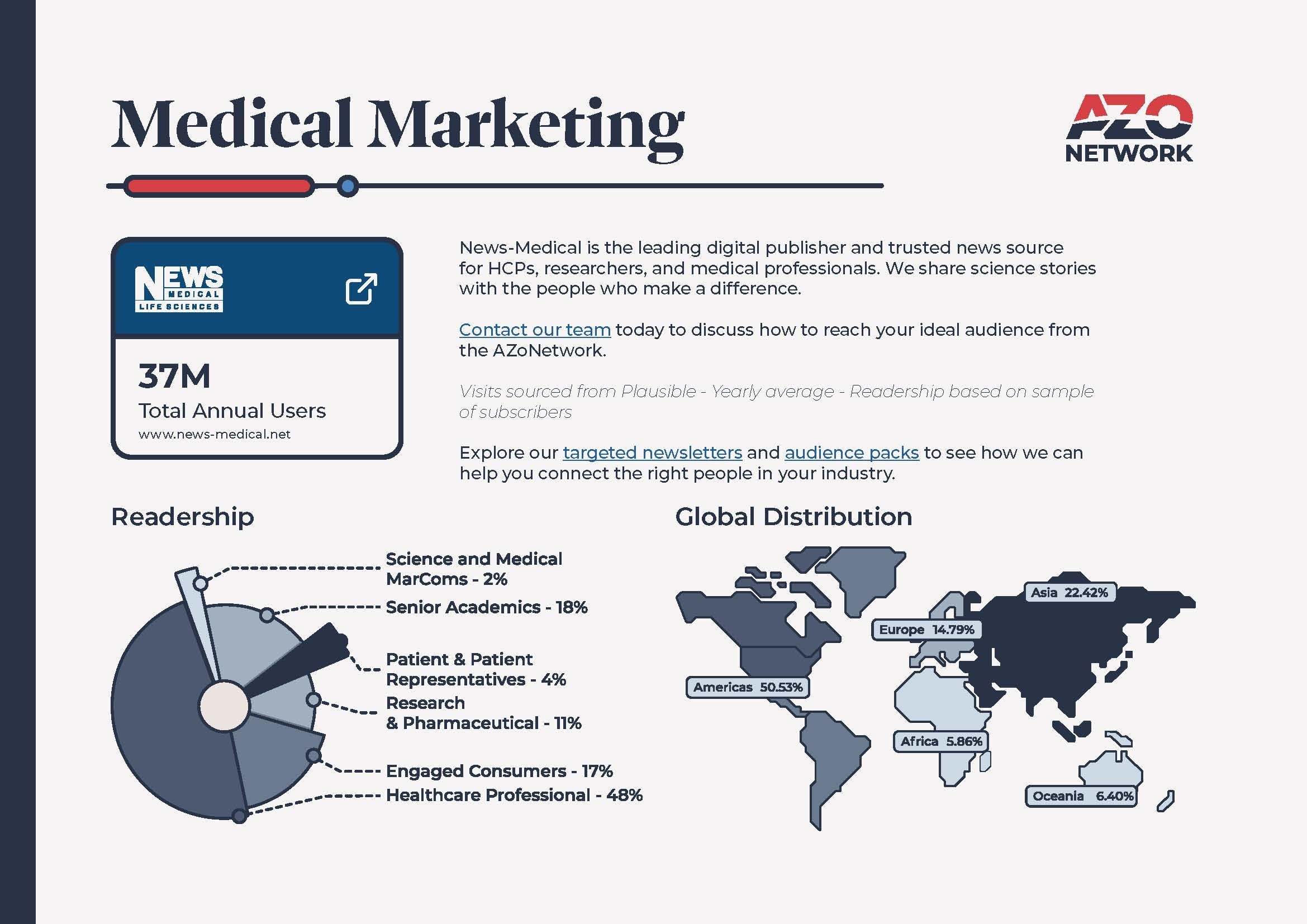
Check out our News-Medical Media Kit here
Informative technical articles, clinical case studies, workflow-focused content, product deep dives, and evidence-backed resources often perform particularly well here because they help buyers assess whether a medical device is relevant to them and would be effective in their daily workflows.
Targeted Email Campaigns
Email is one of the easiest ways to stay in contact with people already interested in your medical device, especially during longer healthcare buying journeys. It allows medical device companies to share technical content, clinical insights, product updates, and evidence-led resources directly with healthcare teams evaluating or comparing new technologies.
A successful email campaign makes the content relevant to the people receiving it. Segment audiences by specialty or clinical area to deliver information that matches their interests, challenges, or work. You can also include technical guides, product summaries, case studies, and downloadable resources to keep your audience engaged, especially if paired with a clear and simple call to action.
Implementing more targeted email campaigns can attract higher-quality leads, improve conversion rates, and reduce wasted outreach by sending out relevant content that matches the interests of the audience.
Learn more about Targeted Emails
Industry Newsletter Placements
Healthcare newsletters have already built the audience that medical device companies are trying to reach. Readers tend to pick up these pieces when actively searching for clinical insights, technical information, and new technologies relevant to their work. So, a well-placed piece of content in a trusted healthcare newsletter cannot go amiss for achieving visibility.
The most useful content for industry newsletters is practical, informative, and easy to engage with quickly. Technical articles, clinical insights, case studies, product updates, and evidence-backed resources often perform well because they offer information that can be applied to day-to-day work or the evaluation process.
Try sending a short educational piece that answers common clinical, operational, or technical questions. This type of content can help generate stronger engagement and attract more qualified leads over time. A medical device brand that establishes early-stage awareness through healthcare newsletters is far more likely to stay visible throughout the buying journey and support stronger conversions later on.
Learn more about Newsletter Sponsorship Here
Medical Conferences and Industry Events
Medical conferences and healthcare events are perfect for finding qualified leads and building credibility within specialist markets. They give healthcare teams the chance to see medical devices in action, ask practical technical questions, and speak directly with the people behind the technology.
That matters more than you might think. According to our State of Scientific Purchasing 2026 report, 42% of respondents said product demos are what attracts them to a booth
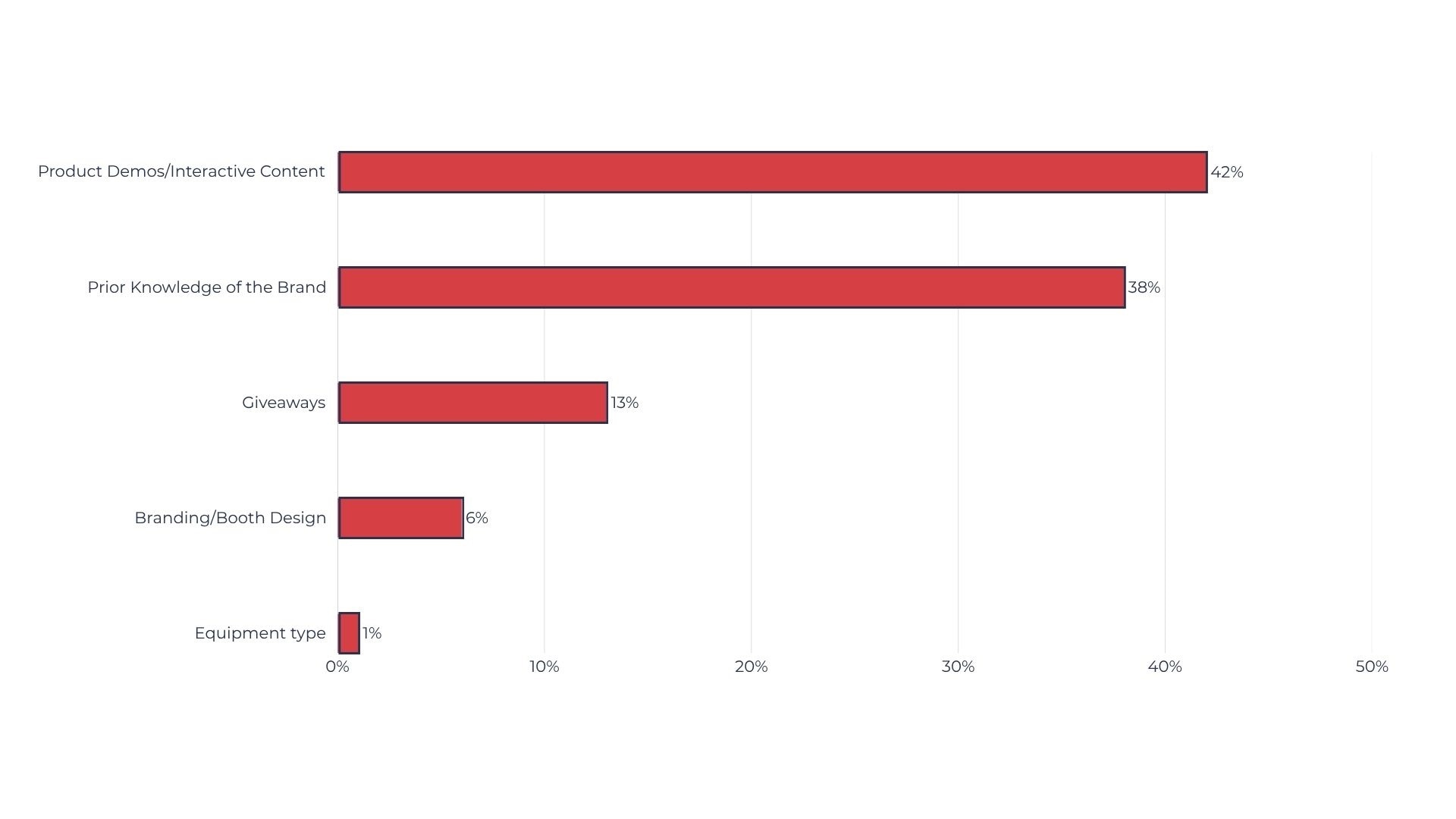
These conversations help clinicians, procurement teams, and technical specialists better understand how a medical device could fit into an existing workflow, what implementation may involve, and if the solution meets their requirements.
Make sure to have content available for distribution during medical conferences and industry events. Technical brochures, clinical case studies, product summaries, and downloadable resources ensure potential buyers can continue to research your medical device after the event has ended. This keeps your company visible throughout the evaluation process.
SEO: Driving Discoverability
If a clinician or engineer is researching new technologies or medical devices, they will likely start their journey on a search engine. SEO is what helps medical device companies appear in those results, ensuring your content reaches people already searching for answers to specific clinical, technical, or operational challenges.
Searches can be about:
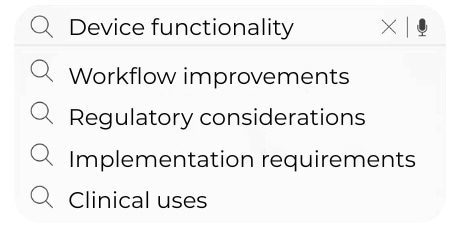 .
.
The key to appearing in those searches is using the language your buyers actually search with. Device-specific terminology, clinical application phrases, and workflow-related search terms all help connect your content with the right audiences. A catheter manufacturer targeting 'biocompatible catheter materials', for instance, will reach a far more relevant audience than one relying on generic product descriptions. Competitor research and basic search engine queries around your device category are a quick way to surface the terms worth targeting.
Long-form educational content compounds that visibility over time. Detailed technical articles, clinical guides, and evidence-led resources help answer the questions buyers are already asking, building authority across multiple search terms and keeping your content discoverable throughout the research process.
Learn more about SEO
Bring Medical Device Content to Life With Expert Voices
Written content is valuable for medical device lead generation, but many healthcare teams also respond well to content that is quicker, more visual, and easier to digest. Videos, webinars, and expert-led discussions can help medical device companies to explain more complex technologies in a way that feels clearer, more practical, and easier to visualise.
Short video demonstrations can bring medical devices to life in a way written content sometimes cannot. Demonstrating setup procedures, workflow improvements, usability, maintenance processes, or day-to-day clinical use can ensure buyers understand how the technology fits into healthcare environments. It also demonstrates what healthcare teams can realistically expect from the medical device in practice before requesting further information.
Want to build credibility? Bringing clinicians, engineers, or industry specialists into your content can make discussions feel far more authentic and trustworthy. Talking to these experts about clinical trends, workflow challenges, or technology adoption often attract highly engaged audiences already interested in that area. It also gives medical device companies a stronger presence within technical healthcare conversations and emerging industry trends.
Learn more about Video
Track What Your Audience Engages With
Audience interests, buyer behaviour, and engagement can all change throughout the research process, which is why it is crucial to keep reviewing your performance data regularly.
Pay attention to the way people interact with your content. Spotting repeat visits to product pages, multiple resource downloads, longer page sessions, webinar attendance, or strong video engagement can all signal that someone is actively researching solutions or moving further into the buying journey. In many cases, these behaviors indicate much stronger buying interest than a single form submission alone.
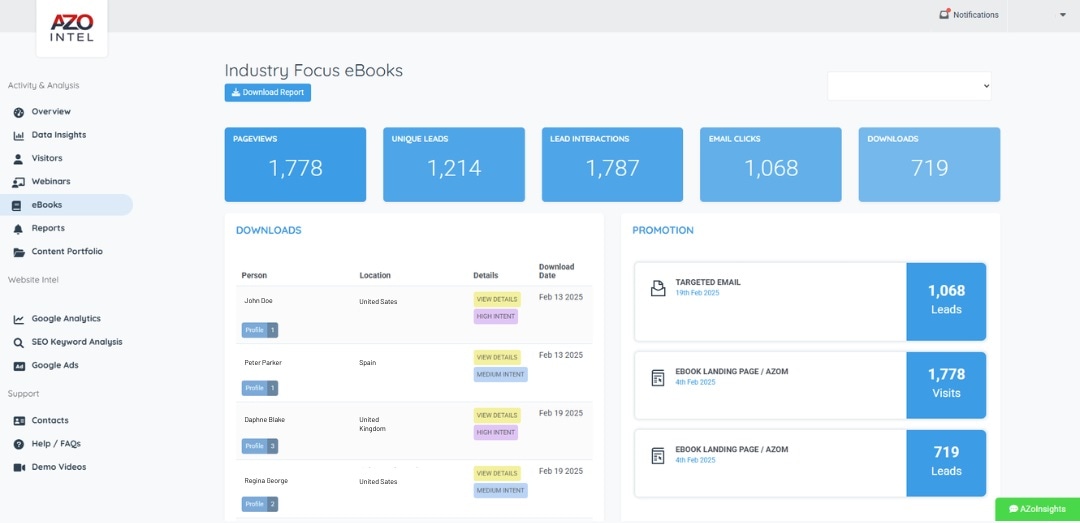
Identifying which content performs best can make lead generation strategies far more effective. Monitoring conversion rates, campaign performance, lead sources, and cost per qualified lead can reveal which channels and content types are attracting the most relevant audiences and where marketing efforts should be adjusted.
The more engagement data you collect, the easier it becomes to refine targeting, improve content strategies, and focus on the channels bringing in the highest-quality leads. That is a lot to keep on top of across multiple campaigns, which is part of the reason we built AZoIntel: to give AZoNetwork clients a single, clear view of how their content and campaigns are performing
Learn more about AZoIntel
Common Mistakes That Affect Lead Quality
Generating qualified leads in the medical device industry can be challenging, particularly when marketing strategies become too broad, overly promotional, or disconnected from what healthcare professionals are actually looking for. Even refined medical devices can struggle to create engagement when content lacks relevance, credibility, or visibility.
Try and avoid these lead generation mistakes:
- Focusing too heavily on promotional messaging instead of practical value
- Targeting audiences that are too broad or not clinically relevant
- Offering very little clinical evidence or technical detail
- Publishing strong content without a clear distribution strategy
- Failing to track engagement, lead quality, or campaign performance.
In many cases, lead generation issues are not caused by weak products, but by communication strategies that fail to connect with the right audience. Clearer messaging, stronger educational content, and more targeted outreach can make a major difference in attracting higher-quality leads.
Searching For Additional Support?
For medical device manufacturers looking for that little bit of extra support with visibility, lead generation, and scientific marketing, AZoNetwork offers a range of targeted services designed to reach specialist healthcare and technical audiences. They include sponsored articles, technical content creation, webinars, expert interviews, newsletter placements, targeted email campaigns, SEO-focused publishing, and video promotion, each of which can improve visibility among relevant scientific and clinical audiences actively researching new technologies and following industry developments.
Whether you are looking to improve visibility, strengthen lead quality, or reach more relevant scientific audiences, AZoNetwork can support medical device companies through targeted content distribution and specialist marketing services.
Contact us today to start crafting your scientific content strategy and let your medical device take centre stage among the audiences who matter most.