60% of Searches End Without a Click. Here's What That Means for Science and Industrial Marketers.
Over a century ago, the Philadelphia department store owner John Wanamaker made a confession that every marketer since has recognised.
"Half the money I spend on advertising is wasted. The trouble is, I don't know which half."
For most of the twentieth century, that was simply the cost of doing business. You placed the ad. You hoped it worked. You moved on.
When we wrote about inbound marketing back in 2016, the promise was that the digital age had finally solved Wanamaker's problem. Online platforms could quantify and measure just how effective your campaigns really were. You could see which content attracted visitors, which pages captured leads, and which touchpoints closed deals. After a hundred years of guesswork, attribution had arrived.
A decade on, it is worth asking whether that promise has held up. Because in 2026, something quietly strange is happening. Six in ten Google searches end without a single click to any website. Buyers are making purchasing decisions in private channels that no tracking pixel can reach. And an increasing share of the research journey is happening inside AI tools that do not pass referral data to anyone.
Wanamaker's problem has not been solved. It has been rewritten.
This is not a crisis. It is a clarification. The rules of digital visibility have changed, and for science and industrial marketers, the change is more significant than most. Here is what it means and, more importantly, what to do about it.
What Is Actually Happening to Search Right Now
Google has been quietly repositioning itself for years, but the shift became impossible to ignore in 2025 and 2026. It has moved from being a referral engine, one that sent users to websites, to an answer engine, one that satisfies the query before the user ever needs to leave.
AI Overviews, featured snippets, and knowledge panels now handle enormous volumes of informational queries directly on the results page. The consequence shows up in the data.
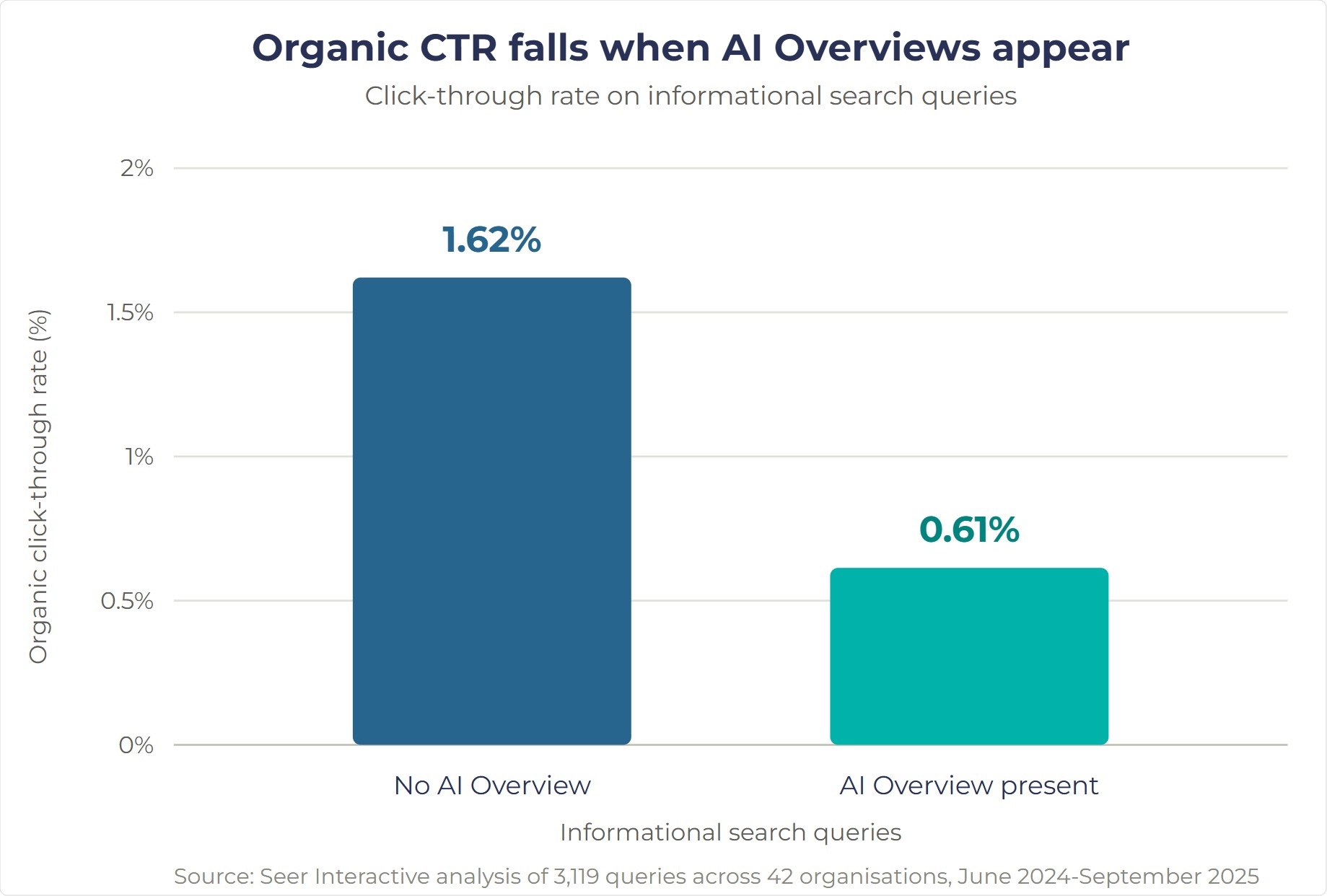
Organic CTR on informational queries fell to 0.61% when Google AI Overviews appeared, versus 1.62% when they did not - from Seer Interactive's analysis of 3,119 queries across 42 organisations (June 2024 to September 2025).
The HubSpot story is the one that focuses minds. Third-party SEO tool estimates point to a steep decline in HubSpot's blog organic-search visibility around late 2024 and into 2025, with Semrush data suggesting a drop from roughly 13.5 million monthly organic visits in November 2024 to around 8.6 million by December 2024. Analysis by Aleyda Solis found that much of the decline was concentrated in broad, top-of-funnel content that had ranked for very general queries - precisely the kind of informational request that AI summaries handle most efficiently.
The lesson is not that content marketing failed. It is that traffic was always a proxy for something else: reach, trust, and intent. Those qualities have not disappeared. They have just moved to places that are harder to count.
Sources: Seer Interactive; MarTech; Aleyda Solis; The Digital Bloom
Why Science and Industrial Marketers Feel This Differently
The zero-click shift affects all sectors, but it lands with particular force in scientific and industrial markets. Understanding why is the first step toward responding well.
Scientific buyers, researchers, procurement managers, laboratory directors, and equipment specifiers do not search the way a consumer does. Their queries are long, technical, and increasingly conversational. A purchasing manager evaluating particle size analysers is not typing two keywords into Google. They are asking a large language model a detailed question and expecting a structured, referenced answer.
In a global survey of nearly 4,000 B2B buyers, 6sense's 2025 Buyer Experience Report found that 94% reported using large language models during their buying process.
Bain and Company report that 85% of B2B buyers purchase from their 'day one' list - the vendors they had in mind before searching - making pre-search visibility critical.
That second figure is the one that should stop you mid-sentence. By the time a research scientist or lab manager formally engages with your brand, they have, in most cases, already decided who they are willing to consider. That shortlist was built through AI queries, peer conversations, and content they encountered weeks or months earlier.
Gartner's 2025 research reinforces the picture: 61% of B2B buyers prefer an overall rep-free buying experience, based on a survey of 632 buyers conducted in August and September 2024. Other research consistently finds that buyers complete a large share of evaluation activities before engaging a sales representative, though the exact proportion varies by study and how the buying journey is defined.
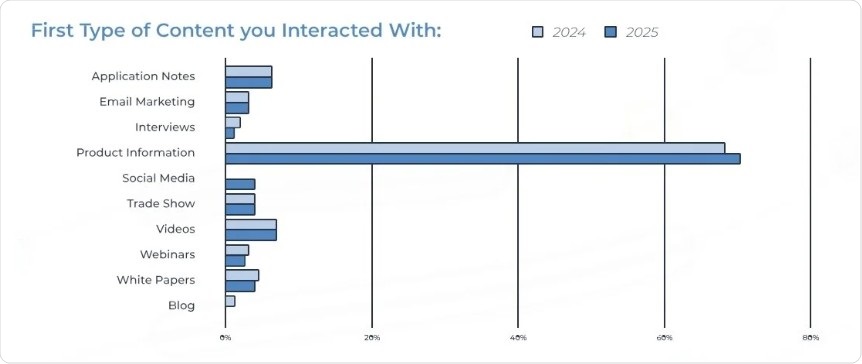
This pattern aligns with what AZoNetwork has observed in our own audience research. In the State of Scientific Purchasing 2026 survey readout, respondents reported that discovery and evaluation are strongly shaped by self-serve research channels, and that clear product information and application-focused content significantly influence which suppliers they consider. In practice, that means brands are more likely to be shortlisted when their technical content is easy to find and genuinely useful early in the research phase, before buyers formally engage with sales.
Sources: 6sense; Bain and Company; Gartner Newsroom; AZoNetwork
The Dark Social Layer Nobody Is Measuring
Zero-click search is one half of the story. The other half is darker and harder to quantify, which is precisely why most marketing teams ignore it.
Dark social refers to content sharing that happens in private, untracked digital spaces. Slack channels. Microsoft Teams threads. WhatsApp groups. LinkedIn direct messages. Email forwards between colleagues. When a procurement manager at a materials testing firm shares an AZoM article with a colleague via Teams, or a researcher forwards a News-Medical piece into a lab group chat, none of that shows up in your analytics. It appears, if at all, as direct traffic with no referral source.
This is not a new problem. Research from Piwik PRO, tracking how private sharing strips referral data, showed more than a decade ago that a significant volume of website visits attributed to 'direct' traffic were actually arriving from shared links in email, messaging apps, and private channels - what analysts now call dark social. The challenge has grown substantially as professional communication moved further into private platforms.
Dreamdata's 2026 benchmarks report an average B2B buyer journey of 272 days and 88 touchpoints - a scale that, almost by definition, includes conversations and referrals happening well outside the reach of standard web analytics.
This is Wanamaker's dilemma in a new form. The content is doing its job, building awareness, earning trust, prompting conversations. But the attribution trail goes cold the moment it enters a private channel. You cannot see which half is working. You can only build the kind of content that is worth sharing and trust that it is.
Seth Godin's concept of permission marketing is useful here. The content worth sharing is not the content engineered to rank. It is the content that genuinely helps someone solve a real problem or understand something complex. That kind of content travels through peer networks precisely because it earns trust rather than demanding attention.
The academic literature on industrial purchasing is consistent on this point. Research published in the Journal of Business and Industrial Marketing finds that customer references and word-of-mouth are key mechanisms buyers use to reduce uncertainty in complex, high-value purchasing decisions. A Harvard Business Review study similarly found that a large majority of B2B buying processes begin with a referral rather than a sales conversation. Much of that peer-to-peer evaluation happens in private channels and offline conversations that are difficult to attribute in standard analytics and CRM dashboards. The conversation is happening. You just cannot see it in your dashboard.
Sources: Piwik PRO; Dreamdata; Journal of Business and Industrial Marketing; Harvard Business Review
So What Do You Actually Measure Now?
If organic traffic is no longer a reliable indicator of content performance, the obvious question is what to track instead. The answer is a set of metrics that measure trust and visibility rather than volume.
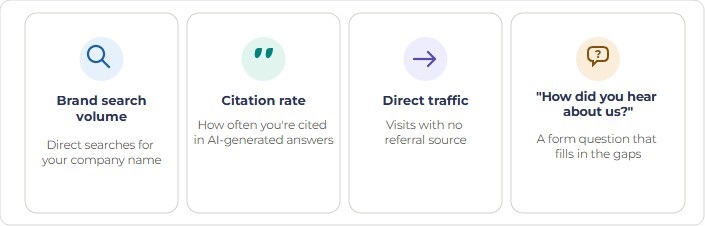
Brand search volume is the one to watch most closely. When someone searches for your company name directly, it means they already know you exist and want to find you specifically. In a zero-click world, that is a meaningful signal. It tells you your content is working somewhere, even if you cannot see exactly where. Branded demand typically lags content investment - which means a programme launched today may not show up in brand search data for several months. Patience and consistency matter more than ever.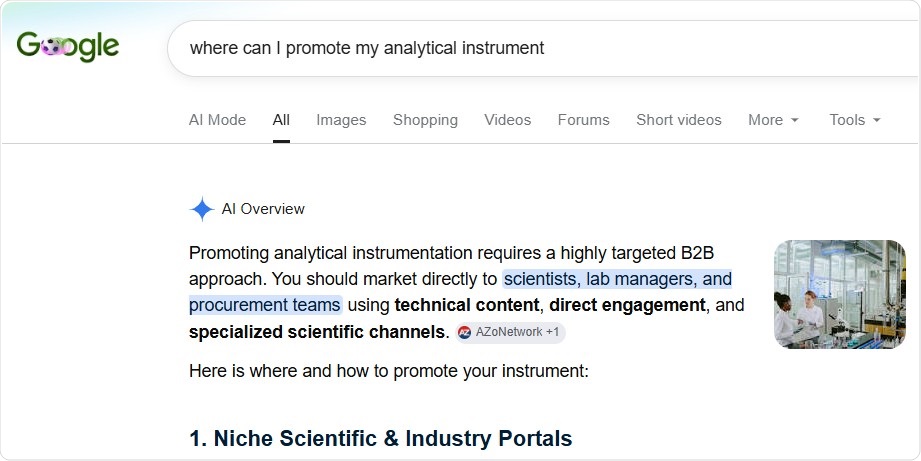
AI citation rates are useful metrics to check
Citation rate is the emerging metric that most B2B teams are not yet tracking. It measures how often your brand appears as a cited source inside an AI Overview or LLM-generated answer. Monitoring this through tools like Semrush Brand Radar or manual prompt testing across ChatGPT, Perplexity, and Google AI is becoming standard practice for content-led marketing teams. Worth noting: a citation and a mention are not the same thing, and knowing the difference changes how you should interpret the number.
Direct traffic deserves more attention than it typically receives. When someone navigates directly to your site without a referral source, it often means they heard about you somewhere you cannot track. That is dark social manifesting as direct visits.
And then there is the simplest fix of all: add an open-ended question to your enquiry forms. 'How did you hear about us?' captures what no analytics platform can. A prospect who found you via a colleague's recommendation, a forwarded article, or an AI-generated response will tell you if you ask. That qualitative data is frequently the most honest indicator of where your content is actually travelling.
Wanamaker never had that option. You do.
Sources: Bain and Company; Dreamdata
What This Means for Your Content Strategy
Knowing what is happening is one thing. Knowing what to do is another. Three shifts are worth prioritising.
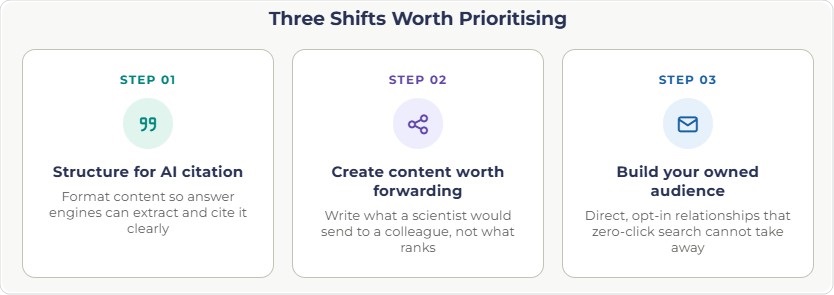
Structure content for AI citation, not just human readers.
Generative Engine Optimisation (GEO) is the practice of formatting content so that AI answer engines can extract and cite it clearly. A March 2026 study from the University of Tokyo and University of Tsukuba found that structural optimisation alone, independent of content quality, produces a consistent 17.3% improvement in AI citation rates across six generative engines. The principles are straightforward: answer the core question in the first 200 words, use clear headings and direct question-and-answer formatting, include original data and specific claims, and ensure your content is published on authoritative, well-indexed domains.
For brands publishing on AZoNetwork's editorial sites, this is an inherent advantage. AZoM, AZoNano, News-Medical, and the wider portfolio carry substantial domain authority built over two decades of specialist scientific content. Content published on these platforms is well-positioned to be cited in AI responses precisely because the authority signals are already there.
Create content that is worth forwarding.
If a large share of content sharing happens in private channels, then the question to ask of every piece of content is not 'will this rank?' but 'would a scientist forward this to a colleague?' The answer is rarely a keyword-optimised product page. It is usually a genuinely useful explainer, an original piece of research, an interview with a credible technical expert, or a comparison that saves the reader time.
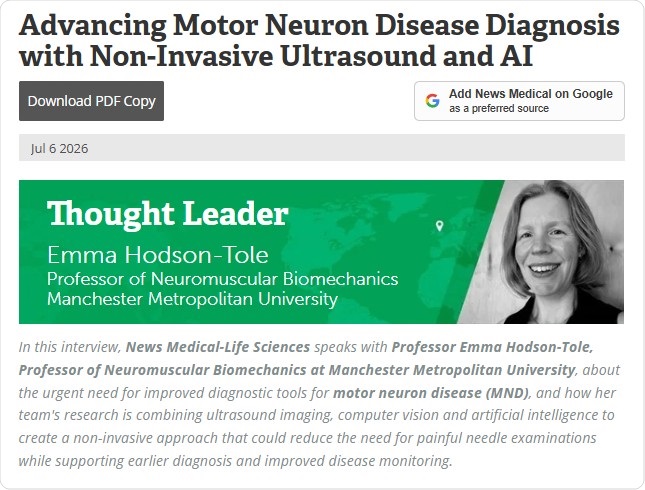
Quality Editorial Content
AZoNetwork's approach to editorial - expert interviews, application notes, and technically rigorous content - is built for exactly this. The model produces content that earns its place in professional conversations because it is genuinely useful to people doing serious work.
Build your owned audience as a hedge.
Email lists, newsletters, and direct relationships are now the most durable marketing asset a science company can build. They do not depend on algorithm changes, search engine policy shifts, or AI model updates. When you send a well-produced newsletter to thousands of procurement managers and researchers in your sector, you are not competing for a click on a results page. You are already in their inbox, with their permission.
The Marketing Science newsletter, and the vertical industry-specific newsletters across AZoNetwork's portfolio, are examples of this model in practice. Direct, regular, opt-in contact with a qualified scientific audience is a channel that zero-click search cannot take away.
Sources: Machine Relations Research; University of Tokyo / University of Tsukuba
The Opportunity Hidden in All of This
It would be easy to read all of this as bad news. Traffic is falling. Attribution is harder. Buyers are making decisions in channels you cannot see. But there is a reframe worth sitting with.
Science and industrial marketers have never been able to rely on volume. Their audiences are small, credentialled, and deeply peer-influenced. They do not respond well to high-frequency, keyword-stuffed content. The marketing tactics that the zero-click world is dismantling, broad informational content optimised for traffic rather than trust, were never particularly effective in this sector anyway.
The brands that invested in genuine expertise, credible editorial, consistent presence on trusted specialist platforms, and real relationships with scientific communities, are already positioned for this world. The shift rewards exactly the kind of patient, authoritative, audience-first marketing that science and industrial companies are well suited to.
If your analytics dashboard looks a little quieter than it did two years ago, that is not necessarily a sign that your content is failing. It may be a sign that your content is travelling through conversations you cannot see, building a vendor shortlist in the minds of buyers who have not yet picked up the phone.
Wanamaker could not know which half of his advertising was working. In 2026, neither can you, not entirely. But you can build the kind of content and presence that means the invisible half is working very hard indeed.
Find Out Where Your Brand Stands in AI Search
AZoNetwork's AI Visibility Report shows how science and industrial brands are performing across AI-generated search responses, where you are being cited, where you are invisible, and what to do about it.
Request Your Personalized AI Visibility Report
Sources
McDonald, Seer Interactive, 'AIO Impact on Google CTR: September 2025 Update', 2025 - seerinteractive.com/insights/aio-impact-on-google-ctr-september-2025-update
Goodwin, MarTech, 'HubSpot's SEO Collapse: What Went Wrong and Why?', 2025 - martech.org/hubspots-seo-collapse-what-went-wrong-and-why
Solis, 'HubSpot's Blog Organic Search Traffic Drop: What Really Happened?', 2024 - aleydasolis.com/en/search-engine-optimization/hubspot-blog-rankings-drop-analysis
Kuriatnyk, The Digital Bloom, 'Organic Traffic Crisis Report 2026 Update', 2026 - thedigitalbloom.com/learn/organic-traffic-crisis-report-2026-update
6sense, '2025 B2B Buyer Experience Report: How AI Is (and Isn't) Disrupting Buying Journeys' - 6sense.com/science-of-b2b/buyer-experience-report-2025
Bain and Company, 'Losing Control: How Zero-Click Search Affects B2B Marketers' (Snap Chart) - bain.com/insights/losing-control-how-zero-click-search-affects-b2b-marketers-snap-chart
Gartner Newsroom, 'Gartner Sales Survey Finds 61% of B2B Buyers Prefer a Rep-Free Buying Experience', June 2025 - gartner.com/en/newsroom/press-releases/2025-06-25-gartner-sales-survey-finds-61-percent-of-b2b-buyers-prefer-a-rep-free-buying-experience
Barker, AZoNetwork, 'State of Scientific Purchasing 2026', 2026 - azonetwork.com/marketing-science/blog/state-of-scientific-purchasing-2026
Piwik PRO, 'Direct Traffic is Not Direct', 2012 - piwik.pro/blog/direct-traffic-dark-social
Flygare, Dreamdata, 'Mapping the B2B Customer Journey: Strategies, Stages, and Tools', 2026 - dreamdata.io/library/b2b-customer-journey-map
Dreamdata, 'Announcing the 2026 LinkedIn Ads Benchmarks Report', 2026 - dreamdata.io/blog/announcing-linkedin-ads-benchmarks-report-2026
Aarikka-Stenroos and Makkonen, 'Industrial Buyers' Use of References, Word-of-Mouth and Reputation in Complex Buying Situations', Journal of Business and Industrial Marketing, 2014 - doi.org/10.1108/JBIM-08-2013-0164
Minsky and Quesenberry, 'How B2B Sales Can Benefit from Social Selling', Harvard Business Review, 2016 - hbr.org/2016/11/84-of-b2b-sales-start-with-a-referral-not-a-salesperson
Machine Relations Research, 'Content Structure and AI Citation Rates: The GEO-SFE Framework', 2026 - machinerelations.ai
AZoNetwork Marketing Science, 'What is Inbound Marketing?', 2016 - azonetwork.com/marketing-science/blog/what-is-inbound-marketing