Plenty of clicks, but not enough serious enquiries?
That's a familiar problem in scientific Google Ads. A campaign for a £50,000+ instrument can attract people looking for everything from journal articles and definitions to jobs and university coursework. The search may look relevant to Google. However, the resulting lead may have little or no commercial intent.
For manufacturers and suppliers of scientific instruments like spectrometers, microscopes, chromatography systems, and other specialised equipment, effective paid search depends on precision. The right conversion signals, keywords, campaign settings, and landing pages all help separate technical curiosity from buying intent.
If your campaigns are spending without generating enough qualified leads, start with these 5 areas.
 Key Takeaways
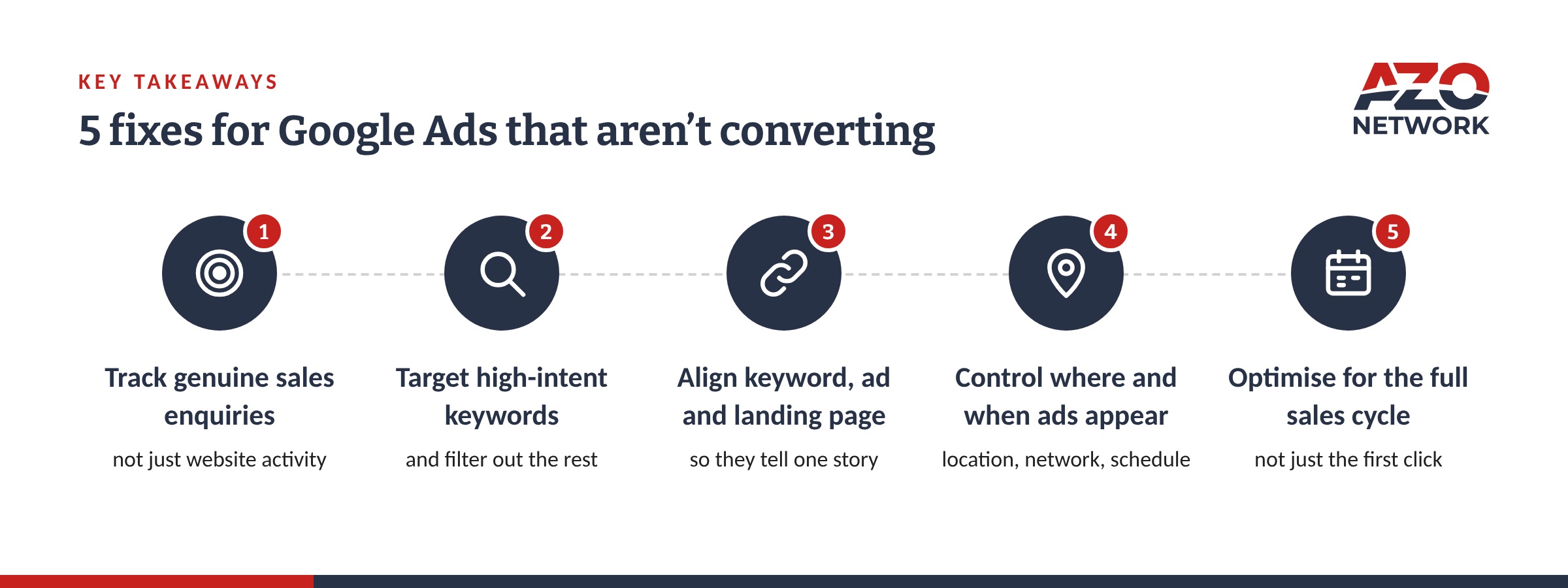
- Track genuine sales enquiries, not just website activity
- Target keywords that show clear buying intent
- Keep keywords, ads, and landing pages closely aligned
- Control where and when your ads appear
- Optimise for the full scientific sales cycle, not just the first click
1. Your Conversion Tracking Is Measuring the Wrong Things
As Alex, our Google Ads specialist, puts it, "The biggest reason scientific campaigns fail is usually that they haven't set conversions up properly."
Not every website action has equal value. Someone downloading a brochure or scrolling through a product page may be interested, which is very different from someone asking for a quote, booking a demo, or speaking to an application specialist.
This is where conversion tracking can start to work against you. If Google Ads is told that every small interaction counts as a success, it may optimise the actions that are easiest to generate instead of the ones most likely to become sales opportunities.
A simple way to separate them is as follows:
- Primary conversions - quote requests, demo bookings, completed contact forms, phone calls, or other clear sales enquiries.
- Secondary conversions - brochure downloads, page views, scroll depth, video views, or other useful engagement signals.
Google Ads can use primary conversions to guide campaign optimisation, and secondary conversions can still be tracked for analysis. This helps the system focus on the actions that are more likely to signal genuine buying intent.
Use Google Tag Manager or confirmation pages to make sure high-value actions such as "request a quote", "book a demo", and "contact an application specialist" are recorded accurately. Where possible, go one step further and send qualified lead outcomes from your customer relationship management (CRM) system back into Google Ads. Google can then learn which visitors completed a form, as well as which enquiries went on to become meaningful opportunities for your sales team.
2. Your Keyword Targeting Is Too Broad for a Specialist Market
Broad keyword targeting in Google Ads can also cause problems. A search for "Raman spectroscopy" can come from someone comparing instruments, or a student writing a report. Broader match can widen that reach further by triggering ads for related searches that do not use your exact keyword. This means your ads can appear for searches with little or no commercial intent.
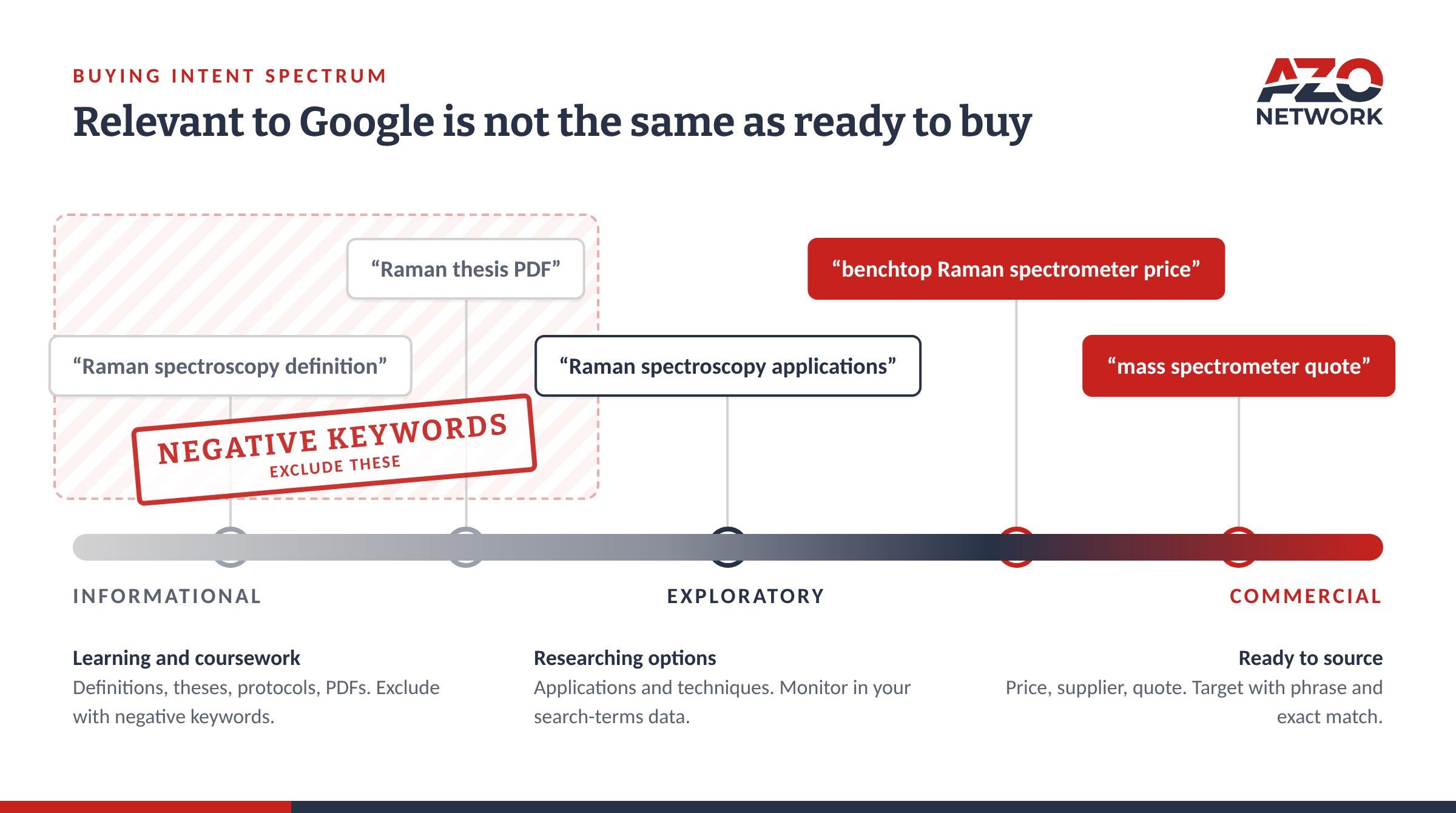
In scientific instrument campaigns, stronger keywords tend to reflect active comparison, pricing research, or plans to source equipment. Phrase and exact match terms such as "benchtop Raman spectrometer price", "SEM supplier UK", or "mass spectrometer quote" can give you tighter control. Broad match is still worth testing, though only alongside Smart Bidding, Google's automated bidding system, and dependable conversion tracking.
Negative keywords can filter out obvious non-buyers. Searches containing terms such as journal, thesis, definition, free, salary, careers, protocol, or PDF may be worth excluding because they often signal informational, academic, or employment-related intent. The important point is to base negative keyword decisions on your actual search-term data, not just on a fixed list. Google Ads supports negative keyword lists across Search campaigns, so keep checking your search terms and expand the list as new patterns appear.
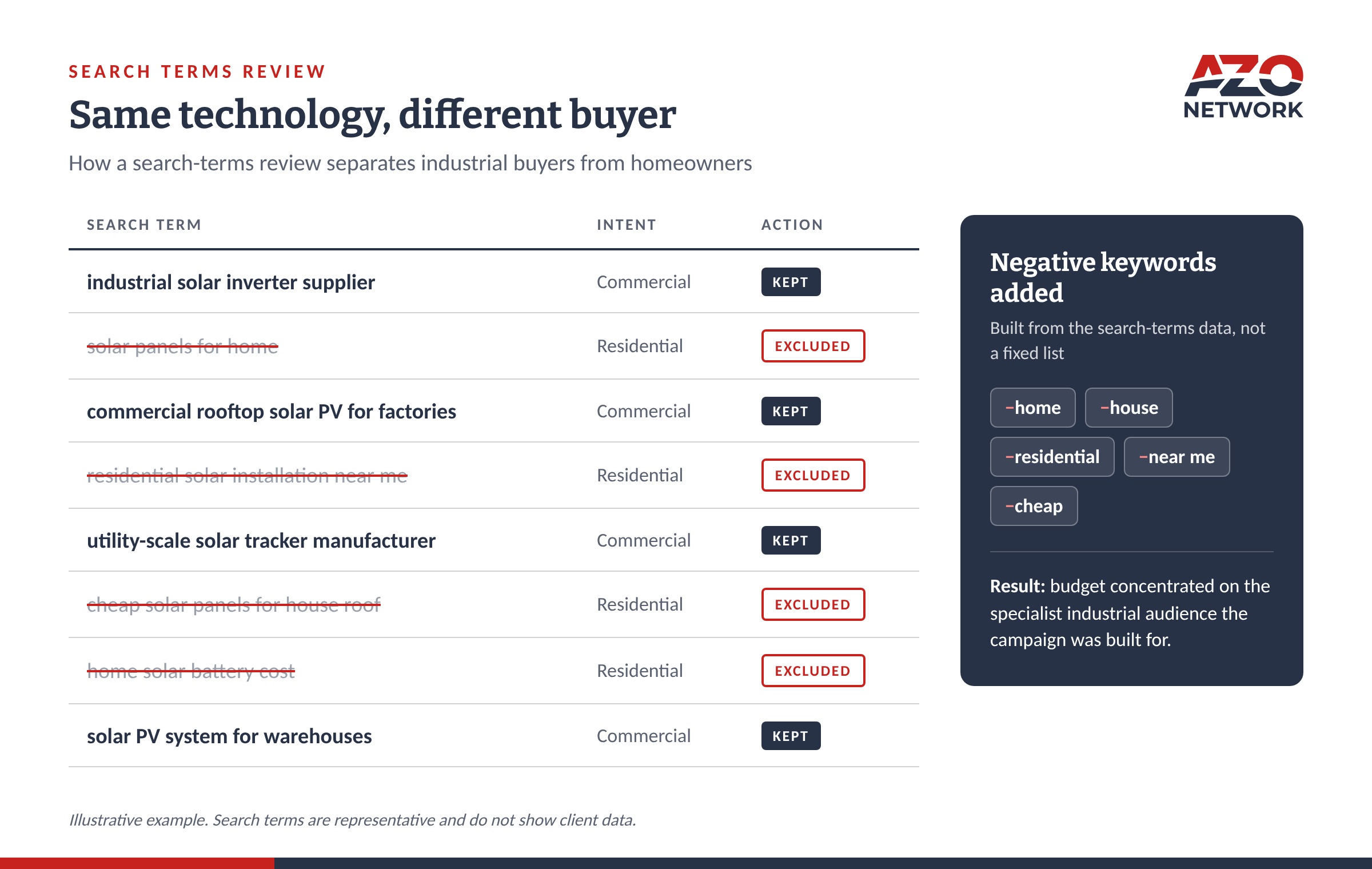
We've seen this first-hand at AZoNetwork. One client running Google Ads for an industrial solar product was attracting searches from people looking for residential solar panels and home installation services. The searches were related to solar technology, but the people clicking were interested in something entirely different. Identifying these patterns in the search-term data meant irrelevant queries could be excluded, helping concentrate the campaign budget on the specialist audiences the client wanted to reach.
3. Your Keyword, Ad, and Landing Page Do Not Tell the Same Technical Story
Scientific buyers notice vague copy quickly. If a buyer searches for a "high-resolution X-ray diffractometer for thin films" and sees "top laboratory equipment", the ad has already lost relevance. Sending that click to a generic homepage adds another obstacle, as this can make it harder to find the right product, application, or technical information quickly.
To improve relevance, build tightly themed ad groups around a product, application, or technique, carrying that focus across the headline, description, and landing page. With a thin-film X-ray diffraction (XRD) query, highlight details such as resolution, sample type, geometry, or application instead of broad corporate claims.
Just as critically, the landing page should make the next step in the buying process obvious by including relevant specifications and a clear commercial call to action near the top. "Request technical datasheet and quote" is more useful than "learn more" when a visitor is comparing instruments. This mirrors AZoNetwork's scientific approach with Google Ads, where URLs, landing pages, keywords, titles, and descriptions are aligned around search intent and commercial relevance.
4. Your Budget Is Being Spent Outside Your Target Market
Your campaign settings can send ads beyond the regions your sales and services teams actually cover, wasting budget on enquiries you cannot support.
Google's default location targeting may reach people outside your chosen area if their searches show interest in it. When sales or service coverage is limited to specific territories, the "presence" setting narrows delivery to people who are in, or regularly in, those locations.
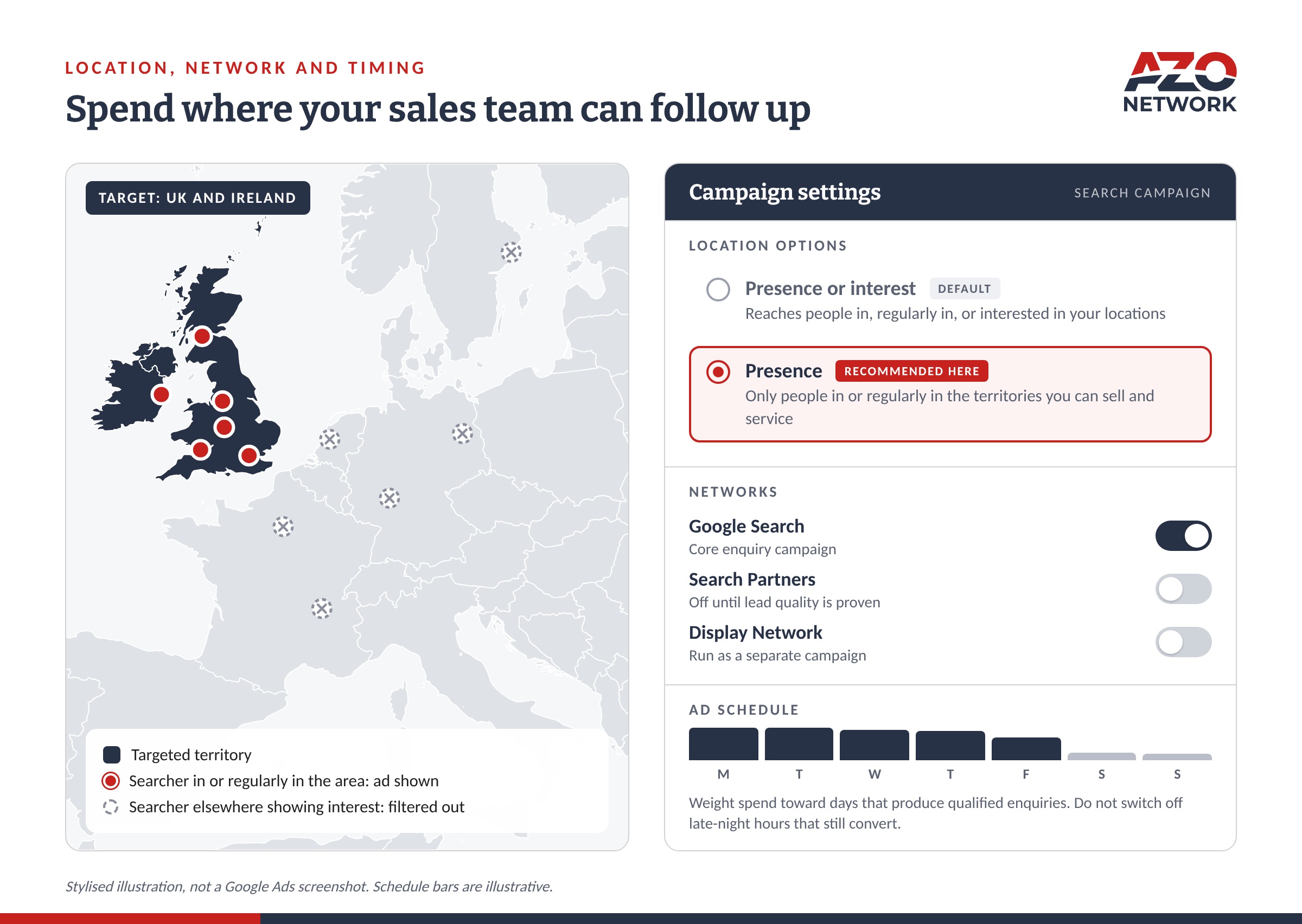
Make sure to consider your network settings. Search Partners can extend reach, although lead quality should determine whether they stay active. Display prospecting and remarketing are better kept separate from core Search activity, giving each its own budget and reporting. Google Ads also provides controls over Search and Display Network participation.
Timing matters too. Use enquiry patterns to shape ad schedules, directing more spend toward periods that generate qualified leads. Late-night conversions can still be valuable, so avoid cutting traffic purely because it falls outside standard working hours.
5. You're Treating a Long Scientific Sales Cycle Like a One-Click Purchase
High-value scientific instruments rarely progress to a purchase order through a single search. Depending on the product, budget approval and procurement process, evaluation can extend over many months and involve a principal investigator, lab manager, procurement team and finance, meaning conversion may take longer than early campaign activity suggests.
Campaign management needs to continue after the initial launch. From there, test ad copy, sitelinks, callouts, bids, and landing page messages to see which combinations create stronger enquiries. As patterns emerge, shift your budget toward the search terms and themes producing qualified leads. Remarketing can extend that momentum by keeping your brand visible to visitors who viewed important product or application pages and are still comparing options.
Be mindful that long sales cycles can still produce useful signals. Demo requests, technical consultations, quote forms, and sales-qualified leads can show whether the campaign is moving in the right direction well before a purchase order appears. The key is to judge momentum across the full sales cycle, using meaningful enquiries and qualified leads as signs of genuine progress.
How AZoNetwork's Google Ads Approach Works
Strong scientific pay-per-click (PPC) through Google Ads needs more than well-written ads. Tracking, targeting, landing pages, and ongoing optimisation all need to support the way technical buyers actually research complex equipment.
AZoNetwork brings these elements into a cohesive strategy through specialist Google Ads management built around scientific audiences and technical search intent. In practice, our service follows three core stages, covering research and campaign setup, ongoing refinement, and performance-led growth.
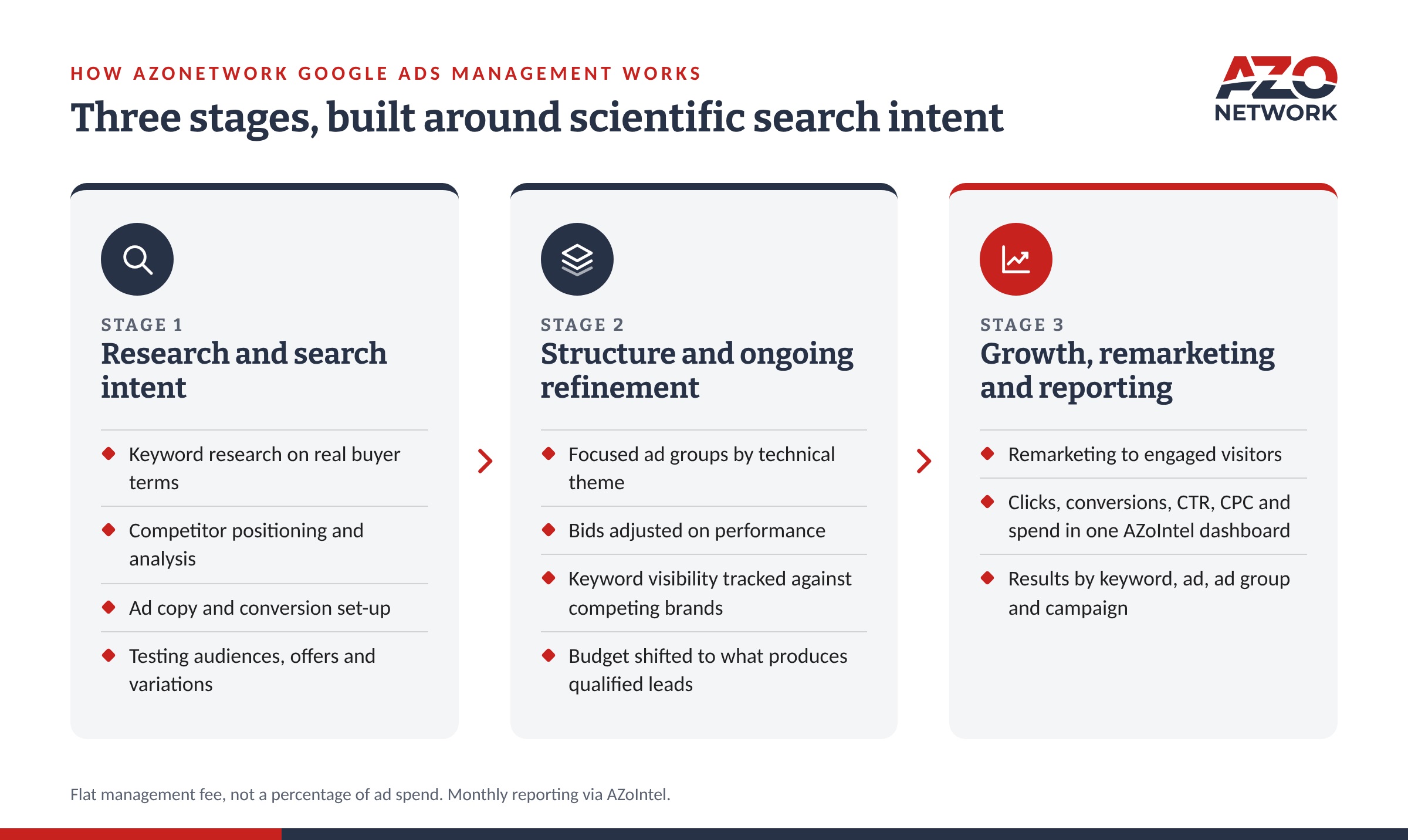
- Keyword research and search intent - We start by looking at the terms scientific buyers are actually using, how competitors have positioned themselves, and which messages are most likely to resonate. That covers keyword research, competitor analysis, ad copy, and conversion management, alongside testing audiences, offers, and ad variations against real search intent.
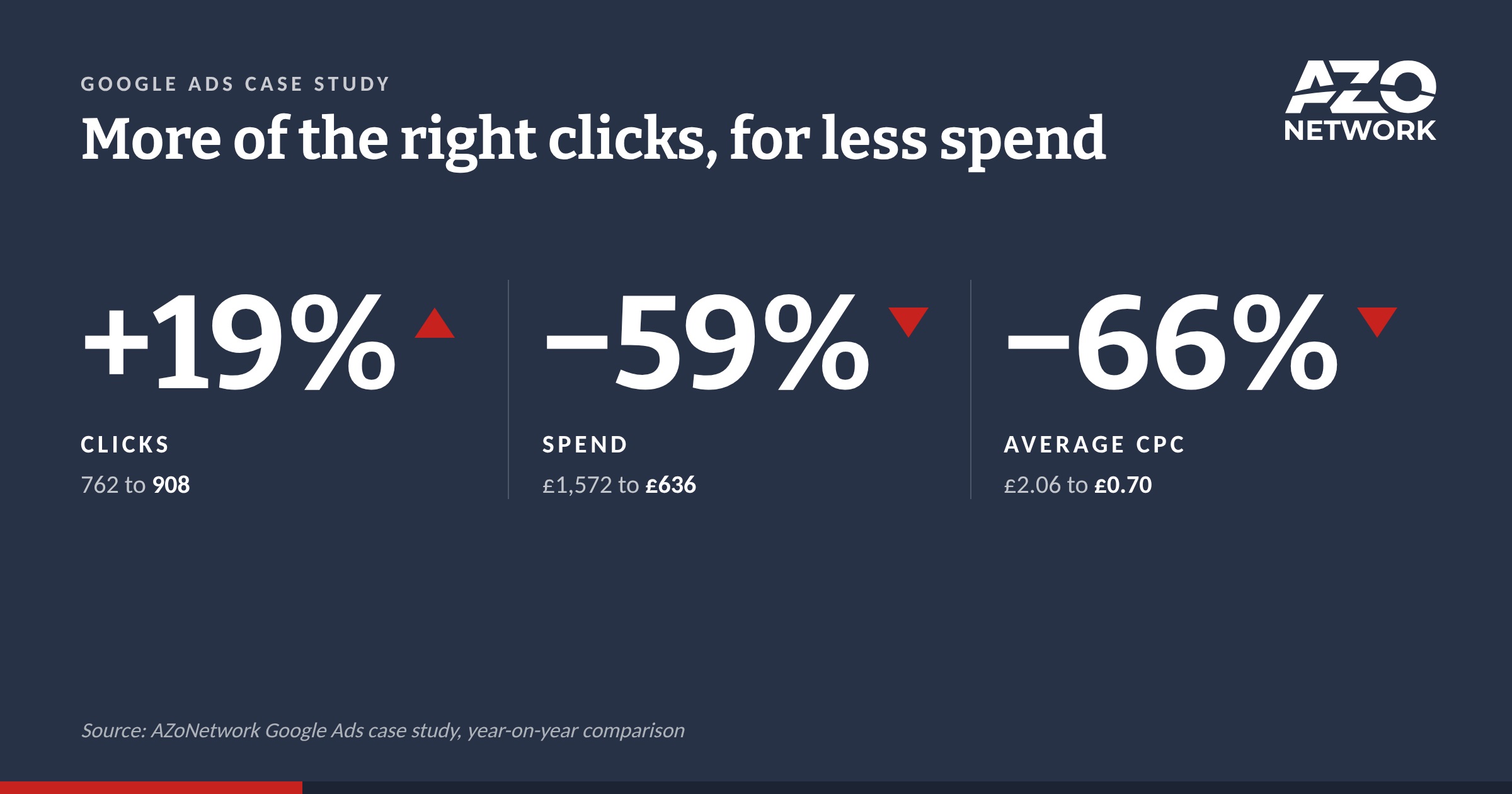
- Campaign structure and ongoing refinement - Once campaigns are running, related technical search themes are organised into focused ad groups, with bid levels adjusted according to performance and keyword visibility measured against competing brands. In a case study for Google Ads, our client's clicks rose by 19% as spend dropped by 59% and average cost per click fell by 66%. These figures show strong traffic and cost efficiency. Conversion performance is tracked separately.
- Growth, remarketing, and reporting - AZoIntel brings clicks, impressions, conversions, click-through rate (CTR), average cost per click (CPC), and total spend into one dashboard. The results are broken down by keyword, ad, ad group, and campaign.
Using AZoNetwork's Google Ads management services gives scientific marketers a more coordinated way to manage paid search. Specialist knowledge, ongoing campaign support, and accessible reporting make it easier to stay focused on commercial goals and understand how activity is progressing over time.
Make Every Click Count
By working with AZoNetwork, scientific brands can tap into specialist market expertise at every stage of Google Ads management, homing in on the searches and audiences that matter most. Explore AZoNetwork's Google Ads management services, read through our product pack, or request a campaign audit today. Our experts are ready to help you turn paid search into a more focused and commercially useful channel.